Work that holds up in production.
Agents, connectors, apps and client work, each led with the result and followed by how the AI part actually works.
Local SEO, taken seriously: a contractor at #1.
Through AnovaGrowth I ran this as an SEO project first: a technically sound website built to rank, a fully optimized Google Business Profile, consistent local citations, and a review-generation system feeding it real signal. Social presence, an autonomous chatbot and an inbound-call AI agent came after the foundation was already ranking. The client stays unnamed on purpose; the results don't need the name.
What actually moved the ranking: on-page technical work (site speed, structure, local schema), a profile kept current and fully categorized, and reviews arriving on a steady cadence instead of in occasional bursts, the pattern Google rewards in the local pack.
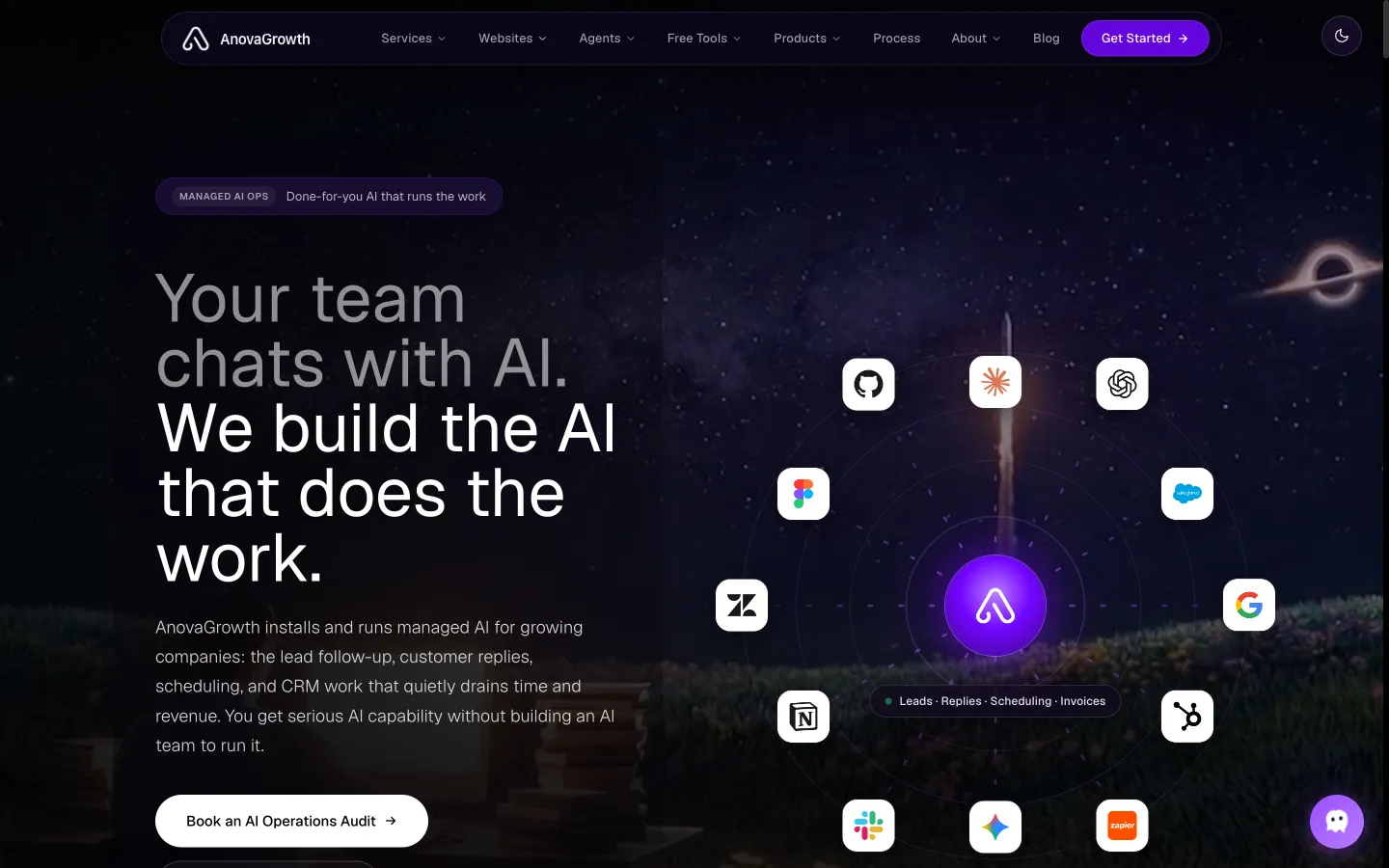
Live capture of anovagrowth.com, the consultancy I founded and run.
The result first, then how it got built.
Most of my AI work happens inside businesses, where the screens and the data aren't mine to show. So each case study walks through the problem, what I built, how the AI part works and what changed. Open any row for the full story.
In-house AI at a large commercial manufacturer
From 2024 to 2026 I ran marketing automation and then led AI and marketing automation inside a large commercial manufacturer. The company stays unnamed here, and none of its tools, screens, data or numbers are shown. What is left is the part worth learning from: the problem, what I built, and how the AI actually did its job.
Agent systemsThe team's first multi-agent frameworkAn agent setup the whole marketing team could lean on, which meant sending far less work to outside agencies and single-purpose software.
The problem
Work that could have been done in-house kept going out to agencies and to software subscriptions that each did one thing. When people did use AI, it was one-off prompts that nobody could repeat or build on.
What I built
I designed and built the team's first internal multi-agent framework on Claude and the Model Context Protocol. Each agent had a defined job and only the tool access that job needed, and the framework carried work from one step to the next instead of leaving a person to copy results between windows.
How the AI part works
Claude does the reasoning and the writing. MCP gives it a controlled way into the business systems. The guardrails are what make it more than a demo: scoped tool access, capped outputs, a system contract the model can't talk its way out of, and a person reviewing anything that leaves the building.
What changed
Sales reps across the company ended up using tools built on it, and the team leaned on far fewer outside agencies and software subscriptions.
Not shown: No internal names, prompts, screens or figures from the original work are published.
MCP serversConnectors into the platforms people already usedAgents that could find, check and change things in real business systems, instead of only talking about them.
The problem
An agent is only useful if it can work where the team works. Here that meant a sales-enablement content library, an events platform and the CRM, each with its own permissions, quirks and gaps between what the documentation promised and what the account could actually do.
What I built
I built Model Context Protocol servers for each of them. The content-library server covered the job end to end: finding and managing assets, content operations, batch jobs and reporting, plus a command-line toolkit and app templates. The events server was generated from the platform's API spec and secured with OAuth2, with operation indexing, token caching and the smallest scopes that would do the job.
How the AI part works
I shape tools around tasks, not endpoints. Find the right asset, inspect the record, prepare a specific change, confirm what happened. Every connector was tested against the real account and its permissions, and when a documented feature didn't work in practice, that went on record where the next decision would be made.
What changed
Agents could move work forward inside those systems with a person approving the consequential steps, instead of someone pasting data between tabs.
Not shown: Vendor names, endpoints, credentials and tool lists stay private.
CRM dataCRM cleanup that runs on its ownLead cleanup went from slow manual passes to a job an agent finishes by itself.
The problem
Lead records came in messy and inconsistent. Before anyone could route a lead to the right rep, someone had to clean, dedupe and restructure the data by hand.
What I built
Custom MCP connectors that let an agent read lead records, fix and dedupe them, restructure the fields that routing depends on, and write the result back to the CRM.
How the AI part works
The model handles the judgment calls a rule can't, like recognizing duplicates that don't match character for character. The connector gives it just enough access to do that job and nothing more.
What changed
A cleanup that used to eat repeated manual passes became a background job, and routing could trust the data it was working from.
Not shown: No record counts, fields or customer data are shown.
Internal appScheduling and request apps that replaced an inboxEvery request got an owner and a status, and within weeks the scheduler surfaced a real sales opportunity that would have stayed buried in email.
The problem
Requests for visits and events lived in email threads and a spreadsheet. Nobody could see at a glance what was booked, who owned it or where it stood, and good leads got lost in the back and forth.
What I built
Two small web apps. A scheduler that reads live availability and blocks double bookings before they happen, and a request app with a guided form, an approval flow that fits the size of the request, and an automatic sync into the CRM once a visit is confirmed. I took each one from the first conversation with the people using it to something they relied on.
How the AI part works
I built them with AI-assisted development: I own the product, the workflow and the rollout, and I direct the models through the build instead of hand-writing every line. That is how one marketer ships an internal app in weeks instead of waiting on a quarter's worth of IT backlog.
What changed
The team stopped chasing threads, the CRM finally saw every confirmed visit, and the booking pattern pointed sales at an opportunity nobody had been looking for.
Not shown: Explained here only in general terms. No screenshots, replicas, names or figures from the real app are published.
Email and lifecycleAn email program with AI in the content loopOpens, clicks and click-through climbed steadily over two years and finished above the industry average.
The problem
A large email program needed more variants, more segments and faster testing than a small team could write by hand.
What I built
I ran the program in the marketing automation platform and built AI into the content workflow, with the audience and the offer decided before any copy got generated.
How the AI part works
AI drafted the alternates: different framing, different levels of detail, segment-specific versions. People kept the strategy, the voice and the final call. The useful part was never a cheaper draft. It was more good options to test.
What changed
Engagement rose over two years and ended up ahead of the industry benchmark. I don't credit the model for all of it. The audience and offer decisions mattered just as much.
Not shown: No campaigns, templates or rates from the program are published here.
AdoptionFrom one-off prompts to people building their ownMarketers and executives went from sending AI requests to one person to building their own automations.
The problem
The bottleneck in most organizations isn't model quality. It's that nobody trusts an agent enough to hand it a real task, so everything funnels through whoever 'does the AI stuff'.
What I built
Reusable working methods and credential-free skills people could pick up safely, plus coaching that started from each person's actual work instead of a generic demo.
How the AI part works
Clear scope and review steps did more for adoption than any model upgrade. Once people could see what an agent was allowed to touch and where a person signs off, they were willing to give it real work.
What changed
Marketers and executives started building their own automations, and AI stopped being a single point of failure on the team.
AnovaGrowth: AI for businesses that can't hire an AI team
AnovaGrowth is the consultancy I founded and run. The point is simple: small and mid-sized businesses should get the same kind of AI systems big companies build, without the enterprise price tag.
Client workA contractor at #1, with AI answering the phone#1 in targeted local search and 50+ five-star reviews, with AI picking up when the crew can't.
The problem
A local home-services contractor was invisible in local search, and the calls and questions that did come in landed while the owner was out on jobs.
What I built
The SEO foundation came first: a technically sound website, a fully optimized Google Business Profile, consistent citations and a steady review system. Once that was ranking, I added an autonomous website chatbot and an inbound-call AI agent.
How the AI part works
The chatbot and the call agent handle the first conversation so a question or a call turns into a lead instead of a missed opportunity. The ranking work isn't AI magic. It's the boring fundamentals done consistently.
What changed
The business ranks #1 in its targeted local searches with 50+ five-star reviews and a growing social presence.
Not shown: The client stays unnamed on purpose.
ProductKept: the AI front desk, as a productThe contractor lesson, productized: missed calls turn into booked jobs.
The problem
For a local service business, a missed call is lost revenue. Most 'AI receptionist' demos are chatbots that never connect to how those businesses actually win work.
What I built
A production landing page, an in-browser demo engine, a missed-call text-back flow and an emergency reply path for urgent jobs.
How the AI part works
The demo engine and the text-back flow keep the conversation pointed at a booking, and the emergency path handles urgent jobs differently from routine quote requests.
What changed
Live on its own domain, checked with a real API smoke test and a 12-case engine regression suite.
Agent publishingA research lab written by agents, with receiptsA public research feed where every post comes from a real, auditable agent session.
The problem
AI-written content usually hides how it was made. I wanted the opposite: a publication where you can see which agent did what.
What I built
A multi-agent pipeline with builder, scientist, reasoner and inventor roles that researches, drafts and publishes, with a full audit trail behind each post.
How the AI part works
Splitting the work into roles keeps any one model from grading its own homework, and the audit trail makes every claim traceable.
What changed
A live public research site that doubles as a working test bed for multi-agent pipelines.
In developmentSmarter Sites and the content strategy agentTwo tools aimed at the jobs small businesses put off: updating the website and planning content.
The problem
Small businesses rarely update their sites or plan content, because both mean waiting on someone else.
What I built
Smarter Sites is a conversational website editor: describe the change, watch it render, approve it before it publishes. The content strategy agent keeps gathering information separate from generating strategy, with dated inputs, ideas that expire and corrections that update what it knows.
How the AI part works
Both keep a person at the approval step and record missing evidence instead of pretending coverage is complete.
What changed
Active builds. Neither is presented as a shipped public service yet.
Not shown: Planned integrations are not represented as shipped.
Independent products and my own agent stack
This is where I test ideas on my own time and my own dime. Some are live products, some are prototypes, and each one says which.
Live productSaturView: college football analytics that shows its workLaunched in October 2026: a public analytics product whose assistant can only cite records it actually has.
The problem
Sports analytics tools blur research, results and predictions together, and AI assistants happily invent numbers that sound right.
What I built
Sourced data, rankings, season simulations and an assistant, on a web frontend backed by its own API server. The predictions side lives apart from the retrospective research, so a backtest never gets dressed up as a forecast.
How the AI part works
The assistant is constrained to supported records. If the data doesn't back an answer, it says so instead of improvising.
What changed
A public beta with real users since launch, built and run end to end by me.
Not shown: No predictive-accuracy guarantee and no claimed sportsbook edge.
Agent operationsThe agent stack I run my own work onA coordinator agent, a fleet of workers and the guardrails that keep them honest.
The problem
Running several agents across real projects gets chaotic fast: lost context, duplicated work, and no clear record of what actually got done.
What I built
Nova, a coordinator agent with a defined personality and role that hands work to other agents, backed by self-hosted n8n for workflows. Fleet Kernel is the prototype control layer underneath: durable tasks, scoped tools, model-routing rules, budgets, and completion that only counts when there is evidence. Novabot puts persistent bots, bounded workspaces and group conversations behind a chat and companion iPhone interface.
How the AI part works
Different models for different jobs, routed by policy. Every agent gets a scope, a review step and a hard stop, and 'done' means there is proof, not that a model said so.
What changed
The day-to-day system behind my client work, products and research.
Not shown: Fleet Kernel and Novabot are prototypes and active builds, not production services.
Creative AICreative production with image, video and audio modelsA working media studio instead of a folder of disconnected model calls.
The problem
AI creative tools are scattered across a dozen sites, and nothing keeps track of what was made, with which model, or how to get back to it.
What I built
OpenVision, an owner-operated studio with model discovery, a generation library and remix flows across image, video and lipsync. Daydraft adds a guided Agent mode and a direct Studio mode for image, video, audio and text. I also built a programmatic agent that generates and edits graphics to cut production cost.
How the AI part works
Routing across model providers, so the right model handles each job, with history kept so any result can be remixed later.
What changed
OpenVision runs in production for my own work. Daydraft is a private working app.
Not shown: OpenVision is owner access only. Daydraft is not a public service.
iOSTrace: a car-repair agent for the repair counterA native iPhone app that turns a confusing repair quote into a decision a driver can understand.
The problem
Repair quotes are hard to read and harder to question, so drivers either overpay or walk away unsure.
What I built
SwiftUI onboarding, symptom triage, photo and OCR intake, line-by-line quote verdicts, garage history and a paid continuation flow.
How the AI part works
The agent reads the quote from a photo, checks each line, and labels it fair, high or worth asking about.
What changed
Shipped v1 with a clean build, two UI test suites and 23 screenshot-reviewed screens.
Not shown: Shipped v1 in a private repo. No public App Store release is claimed.
Two more rooms to walk through.
Software
Independent products and experiments, with clear status and access information.
Open the consoleDesign
Websites, interfaces and products from my independent practice, each with its current status.
See the design work
Looking for something specific? Browse every project.